Introduction
Most discussions on Vaastu stop at directions, room placement, or surface-level remedies. Yet classical Vedic Vaastu was never meant to be a decorative guideline. It was designed as a predictive spatial science, where every part of a structure is governed by a specific Devta, carrying a distinct functional responsibility in human life.
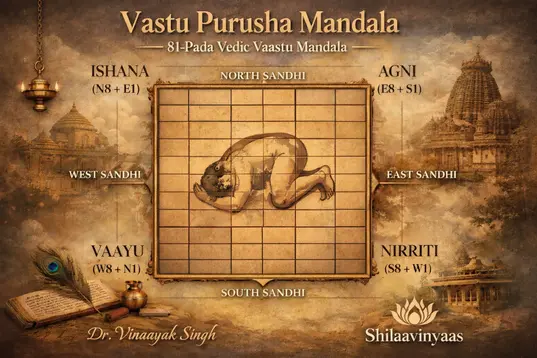
The Vastu Purusha Mandala does not divide space mechanically. It represents a living field of Devtas, their attributes, and their junctions. When these attributes are respected, space supports clarity, stability, health, and growth. When they are violated, imbalance appears as repeating life patterns, sudden events, or unexplained stagnation.
This article presents a pure Vedic framework to understand Vaastu through Devta attributes, sandhi zones, vikriti patterns, and classical corrective logic. It moves beyond myths, color theories, and mixed systems, and returns to the original Mandala-based diagnostic approach described in traditional texts.
The aim is not belief, but understanding. When Vaastu is read correctly, it explains not only where a problem exists, but why it manifests and when it is likely to surface.
1. Panch Mahabhutas in Classical Vedic Vaastu
In Vedic Vaastu, Panch Mahabhutas are cosmic principles, not color codes or décor tricks.
| Mahabhuta | Core Meaning | Governs |
|---|---|---|
| Prithvi (Earth) | Stability, structure | Body, assets, immovable strength |
| Jal (Water) | Flow, nourishment | Mind, emotions, liquidity |
| Agni (Fire) | Transformation | Energy, digestion, action |
| Vayu (Air) | Movement | Breath, circulation, activity |
| Akasha (Space) | Expansion, containment | Consciousness, balance, potential |
These are experienced through direction and form, not imposed using paint.
2. Where Akasha (Space) Truly Resides (This is the Key Point)
In traditional Vedic Vaastu:
- Akasha (Space) is Brahmasthaan
- It is the center, not a corner, not a sector
- It is formless, unobstructed, silent
Brahmasthaan is not owned by any direction or element
It is the witness field where all other elements operate.
So yes:
Saying W to NNW is “Space zone” is not Vedic Vaastu
That concept comes from modern directional zoning + Feng Shui influence, not classical texts.
3. How Directions Work in Classical Vaastu (Important Correction)
In Vedic Vaastu:
- Directions are ruled by Devtas
- Elements emerge from directional behavior, not fixed 72-degree slices
The house is not divided into 5 equal elemental wedges
Instead:
- Elements rise and fall gradually
- No hard borders like “this 45 or 22.5 or 11.25 degrees is only one element”
4. Why Internet Articles Say “W to NNW = Space”
This happens due to:
- Mixing Feng Shui Bagua
- Oversimplifying Panch Tatva for décor marketing
- Creating easy color remedies for non-technical readers
But this causes conceptual damage, especially for serious Vaastu students.
5. Parent–Child Element Theory Clarified
Yes, Panch Mahabhutas have a creation sequence:
Akasha → Vayu → Agni → Jal → Prithvi
But this is:
- Cosmic creation order
- Not house zoning logic
You do not balance excess fire by painting blue walls.
That is a decor myth, not Vaastu.
7. Correct Way to Balance Increased or Decreased Elemental Energy
In Vedic Vaastu, balance is done using:
1. Weight vs Lightness
- Earth imbalance → change load, storage, floor mass
- Not color
2. Openness vs Obstruction
- Vayu imbalance → openings, ventilation, movement paths
- Not wind chimes everywhere
3. Fire Regulation
- Heat sources, cooking, electrical density
- Not red paint removal alone
4. Water Flow
- Slope, drainage, leakage, storage height
- Not blue curtains
5. Space Correction
- Brahmasthaan cleanliness
- No beams, toilets, staircases, pillars
- This is where Akasha is corrected
8. Simple Rule to Remember (Very Important)
Akasha cannot be created by adding anything
It is balanced only by removing obstruction
This single line separates true Vaastu from surface-level content.
9. Then Where Do Colors Come From in Vedic Tradition?
Colors appear in three very specific contexts, none of which mean “paint the wall to fix Vaastu”.
2.1 Color as Guna Indicator, not Remedy
| Guna | Color Tendency | Meaning |
|---|---|---|
| Sattva | White, light, pale | Clarity, balance |
| Rajas | Red, orange | Activity, agitation |
| Tamas | Dark, black | Inertia, heaviness |
This is psychological and ritual, not architectural zoning.
10. Where Panch Mahabhutas Actually Apply
THREE PLACES:
- Brahmasthaan
- Akasha
- Free, empty, silent
- Functional Placement
- Fire activity creates Agni dominance
- Water storage creates Jal dominance
- Structural Behavior
- Heavy = Earth
- Open = Air
- Heated = Fire
11. Increase and Decrease – How Ancient Vaastu Explains It
Ancient Vaastu never says “increase this element”.
It talks about vikriti (distortion).
Example: Excess Fire (Agni Vikriti)
Caused by:
- Kitchen in wrong zone
- Excess electrical load
- Sharp angles
- Heat retention
Effect:
- Anger
- Blood pressure
- Accidents
- Litigation
Correction:
- Shift function
- Ventilation
- Reduce heat sources
- NOT paint blue walls
Example: Weak Water (Jal Kshaya)
Caused by:
- Improper slope
- Leakage
- Missing storage
- Dry SW dominance
Effect:
- Emotional dryness
- Financial flow issues
Correction:
- Correct slope
- Proper storage
- Flow management
Why Color & Metal Remedies Became Popular
Because:
- They are non-invasive
- They are commercial
- They avoid telling people to break walls or shift toilets
But ancient Vaastu never promised easy fixes.
12. Why Corners Are NOT Single Devta Zones (In Energy chart you will find more energy in these corner zone)
In classical texts:
- Directions are continuous
- Energy does not abruptly change
- Corners represent transition + amplification
Therefore:
- A corner inherits attributes of both sides
- Any violation there produces stronger vikriti
This is why:
- NE and SW are considered most sensitive
- Small mistakes create large consequences
13. What Is Sandhi in Vedic Vaastu (Core Principle)
Sandhi = junction + transition + amplification
A sandhi exists wherever two Devta currents meet, not only at corners.
So there are two categories of sandhi:
- Corner Sandhi (Diagonal junctions)
NE, SE, SW, NW
These are Mahā-sandhi (major amplifiers) - Cardinal Sandhi (Axis junctions)
N, S, E, W
These are Madhya-sandhi (functional amplifiers)
Why Cardinal Sandhi MUST Exist
In the 81-Pada Mandala:
- Each side has 8 padas
- The center two padas of each side sit exactly on the axis
- These padas act as transition points between directional halves
Example:
- North is not a single current
- It transitions from NW behavior → NE behavior
- The midpoint is a sandhi of flow
If sandhi did not exist here:
- Energy would jump abruptly
- Which never happens in Vedic cosmology
Continuity is fundamental.
14. Sandhi-Specific Vikriti Patterns (Corner Junction Logic) & Correct Interpretation of Each Corner
Sandhi zones are amplifiers.
A defect here does not create a new problem, it accelerates karmic manifestation.
14.1 NORTH-EAST SANDHI (N8 + E1) – Ishana Sandhi
Devta nature
- N8: Aryaman/Mitra (ethics, social order, trust)
- E1: Ishana–Savita (clarity, consciousness, divine order)
Core function
- Entry of subtle intelligence
- Decision clarity
- Grace, health, learning
Sandhi vikriti patterns
- Chronic confusion despite intelligence
- Medical issues with no clear diagnosis
- Spiritual disinterest or loss of faith
- Sudden loss of guidance figures (guru, mentor, doctor)
- Repeated wrong decisions taken “with confidence”
High-risk violations
- Toilet, staircase, heavy storage
- Fire or heat
- Closed, dark, sunless corner
- Water contamination
Why impact is severe
This sandhi governs why actions are taken, not the action itself.
14.2 SOUTH-EAST SANDHI (E8 + S1) – Agni Sandhi
Devta nature
- E8: Agni (transformation)
- S1: Agni–Yama (discipline of action)
Core function
- Controlled execution
- Metabolism (physical + mental)
- Courage with restraint
Sandhi vikriti patterns
- Anger without cause
- Accidents, burns, cuts
- Litigation, police matters
- Blood pressure, ulcers
- Family conflicts escalating suddenly
High-risk violations
- Excess fire, multiple heat sources
- Electrical overload
- No ventilation
- Improper kitchen alignment
Why impact is severe
This sandhi governs how fast karma manifests.
14.3 SOUTH-WEST SANDHI (S8 + W1) – Nirruti Sandhi
Devta nature
- S8: Rakshasa/Nirruti (loss, decay)
- W1: Rakshasa–Varuna (containment)
Core function
- Stability through weight
- Boundary of protection
- Karma settlement
Sandhi vikriti patterns
- Sudden financial loss
- Relationship breakdowns
- Depression, isolation
- Chronic fear without threat
- Repeated setbacks after success
High-risk violations
- Openings, balconies
- Water elements
- Light construction
- Movement activity
Why impact is severe
This sandhi governs what remains after karma plays out.
14.4 NORTH-WEST SANDHI (W8 + N1) – Vayu Sandhi
Devta nature
- W8: Naga/Vayu (hidden movement)
- N1: Vayu–Naga (sudden shifts)
Core function
- Transition
- Circulation
- Temporary engagements
Sandhi vikriti patterns
- Restlessness
- Job instability
- Anxiety without cause
- Sleep disturbance
- Repeated short-term relationships
High-risk violations
- Excess openings
- Constant movement
- Noise
- Lightweight construction
Why impact is severe
This sandhi governs continuity of life patterns
15. The Four Cardinal Sandhi Defined (Correctly)
15.1 EAST SANDHI (E4–E5 region)
Between
- NE influence (clarity, purity)
- SE influence (action, fire)
Nature
- Decision → execution junction
Governs
- Initiative
- Public image
- First action taken
East Sandhi Vikriti Patterns
- Good ideas but poor execution
- Delays despite opportunity
- Reputation confusion
- Starts that do not sustain
Typical violations
- Obstructions at main entrance
- Mixed fire + water
- Conflicting activities
Correct handling
- Clear entry
- Single intent activity
- Clean, open, disciplined use
15.2 SOUTH SANDHI (S4–S5 region)
Between
- SE (action, fire)
- SW (stability, restraint)
Nature
- Action → consequence junction
Governs
- Discipline
- Responsibility
- Accountability
South Sandhi Vikriti Patterns
- Fear of authority
- Chronic stress
- Guilt without reason
- Punishment-like experiences
Typical violations
- Toilets
- Excess heat
- Chaotic movement
Correct handling
- Quiet, controlled use
- No fire dominance
- Ethical order
15.3 WEST SANDHI (W4–W5 region)
Between
- SW (containment)
- NW (movement)
Nature
- Retention → release junction
Governs
- Maturity
- Long-term results
- Endurance
West Sandhi Vikriti Patterns
- Results come but do not last
- Authority loss after success
- Fatigue after achievement
- Emotional dissatisfaction
Typical violations
- Over-openness
- Continuous movement
- Light construction
Correct handling
- Stability
- Storage
- Calm usage
15.4 NORTH SANDHI (N4–N5 region)
Between
- NW (movement, trade)
- NE (wisdom, purity)
Nature
- Gain → guidance junction
Governs
- Wealth flow with ethics
- Decision on expansion
- Financial intelligence
North Sandhi Vikriti Patterns
- Income without satisfaction
- Money comes but causes problems
- Conflicts over resources
- Ethical dilemmas in growth
Typical violations
- Clutter
- Leakage (water, money)
- Conflicting uses
Correct handling
- Clean flow
- Ethical financial use
- Order and transparency
Corner Sandhi vs Cardinal Sandhi (Very Important Distinction)
| Aspect | Corner Sandhi | Cardinal Sandhi |
|---|---|---|
| Strength | Very high | Moderate |
| Speed of manifestation | Fast | Gradual |
| Nature | Karmic amplifier | Functional regulator |
| Impact | Life-altering | Pattern-altering |
| Forgiveness | Very low | Some tolerance |
This is why:
- Corner mistakes cause sudden events
- Cardinal mistakes cause chronic patterns
Astrology Link for Cardinal Sandhi (Trigger Logic)
East Sandhi
- Sun, Mars periods
- 1st or 10th house activation
South Sandhi
- Saturn periods
- 6th or 12th house activation
West Sandhi
- Sun setting phase, Saturn
- 7th or 10th house pressure
North Sandhi
- Mercury, Jupiter periods
- 2nd or 11th house activation
Again:
Astrology triggers when
Sandhi decides how
Direction decides where
16. Based on Standard 81-Pada, understanding of outer devtas
- East side: E1 (NE corner) → E8 (SE corner)
- South side: S1 (SE) → S8 (SW)
- West side: W1 (SW) → W8 (NW)
- North side: N1 (NW) → N8 (NE)
This numbering is consistent with Manasara and Mayamata grid reading.
EAST SIDE (E1–E8) – Initiative, authority, emergence
| Pada | Devta | Core Attribute | Vikriti Effects (when disturbed) | Classical Correction (Dosha Shamana) | Devta Activation (Vridhi) |
|---|---|---|---|---|---|
| E1 | Ishana-Savita | Spiritual illumination | Confusion, loss of direction, anxiety | Remove clutter, restore purity | Morning sunlight, japa |
| E2 | Savita | Renewal, inspiration | Laziness, lack of motivation | Improve access, cleanliness | Sunrise discipline |
| E3 | Aditya | Vital force, health | Low immunity, ego collapse | Correct fire balance | Surya upasana |
| E4 | Indra | Authority, leadership | Reputation damage | Remove obstruction | Ethical leadership |
| E5 | Jayanta | Victory, ambition | Repeated failures | Restore movement | Goal discipline |
| E6 | Mahendra | Protection, command | Fear, insecurity | Strengthen boundaries | Guarded access |
| E7 | Indra-Agni | Action power | Hesitation, anger | Regulate activity | Right use of fire |
| E8 | Agni | Transformation | Accidents, disputes | Correct fire placement | Controlled Agni karma |
SOUTH SIDE (S1–S8) – Karma, restraint, decay control
| Pada | Devta | Attribute | Vikriti Effects | Classical Correction | Activation |
|---|---|---|---|---|---|
| S1 | Agni-Yama | Discipline of action | Rash decisions | Control aggression | Ethical restraint |
| S2 | Yama | Law, justice | Legal issues, fear | Moral correction | Truthfulness |
| S3 | Vitatha | Truth, order | False blame | Restore order | Honest conduct |
| S4 | Gandharva | Sensory balance | Addiction, indulgence | Remove excess pleasure | Self-control |
| S5 | Bhringraj | Disease cycle | Chronic illness | Remove decay | Cleanliness |
| S6 | Nirruti-Bhringraj | Loss management | Depression | Stabilize mass | Heavy grounding |
| S7 | Nirruti | Destruction | Sudden loss, death-like events | Strengthen SW | Stability, silence |
| S8 | Rakshasa | Protection from negativity | Fear, enemies | Fortify structure | Vigilance |
WEST SIDE (W1–W8) – Stability, maturity, containment
| Pada | Devta | Attribute | Vikriti Effects | Classical Correction | Activation |
|---|---|---|---|---|---|
| W1 | Rakshasa-Varuna | Defense, control | Sudden threats | Secure boundary | Discipline |
| W2 | Varuna | Storage, endurance | Financial stagnation | Correct water logic | Balanced storage |
| W3 | Pushpadanta | Strength | Fatigue | Reduce overload | Rest rhythm |
| W4 | Surya | Authority maturity | Loss of respect | Restore hierarchy | Order |
| W5 | Sugriva | Mental strength | Anxiety | Calm environment | Stability |
| W6 | Pushpadanta-Vayu | Pressure balance | Mental pressure | Reduce stress | Air balance |
| W7 | Vayu | Motion | Restlessness | Control movement | Regulated airflow |
| W8 | Naga | Hidden forces | Sudden shocks | Remove underground faults | Earth purity |
NORTH SIDE (N1–N8) – Wealth, flow, intelligence
| Pada | Devta | Attribute | Vikriti Effects | Classical Correction | Activation |
|---|---|---|---|---|---|
| N1 | Naga-Vayu | Sudden change | Instability | Ground movement | Stability |
| N2 | Vayu | Trade, circulation | Job hopping | Controlled openness | Planned motion |
| N3 | Soma | Mind balance | Mood swings | Emotional regulation | Calm routine |
| N4 | Bhujanga | Resource flow | Financial leakage | Seal leaks | Accounting order |
| N5 | Kubera | Wealth accumulation | Income blockage | Clear access | Ethical earning |
| N6 | Dhanada | Income continuity | Salary delays | Improve pathways | Regularity |
| N7 | Mitra | Trust | Relationship conflicts | Harmonize use | Cooperation |
| N8 | Aryaman | Social order | Disputes | Restore ethics | Right conduct |
What “Activation” Means in Vedic Vaastu (Critical Clarification)
Activation does NOT mean adding objects.
Activation means:
- Using the zone as per Devta function
- Allowing natural expression
- Maintaining discipline and purity
- Aligning human behavior with Devta order
A Devta is activated by right use, not by decoration.
Absolute Vedic Rule (From Mayamata Spirit)
“Dosha arises not from space,
but from misuse of space.”
Why This Framework Works
- Devtas govern karma
- Vikriti manifests as life events
- Correction restores cosmic order
- Activation sustains long-term harmony
16. Doing Professional Audit using Devta-Wise Diagnostic Questions
These questions are asked to the occupant, not inferred from belief.
Ishana Sandhi (NE)
- Do you struggle to take confident decisions?
- Do problems exist without clear cause?
- Are mentors or guides frequently lost or ineffective?
- Do health issues remain unexplained?
Agni Sandhi (SE)
- Do conflicts escalate suddenly?
- Any history of burns, cuts, accidents?
- Is anger quick and regret later?
- Legal or authority issues recurring?
Nirruti Sandhi (SW)
- Did life feel stable once but collapse suddenly?
- Is money earned but not retained?
- Do relationships end abruptly?
- Is there a sense of emotional heaviness?
Vayu Sandhi (NW)
- Frequent job or residence changes?
- Difficulty committing long-term?
- Mental restlessness?
- Sleep pattern irregular?
If 3 or more answers are yes, sandhi vikriti is active.
17. Linking Sandhi Dosha with Astrology (Trigger Mechanism)
Vaastu dosha is static.
Astrology activates it in time.
3.1 NE Sandhi Triggers
- Jupiter transit or dasha
- Ketu influence
- Affliction to 9th or 5th house
Manifestation: loss of guidance, wrong decisions
3.2 SE Sandhi Triggers
- Mars dasha/transit
- Sun affliction
- 6th or 8th house activation
Manifestation: accidents, litigation
3.3 SW Sandhi Triggers
- Saturn dasha/transit
- Rahu–Ketu axis involvement
- 8th or 12th house activation
Manifestation: loss, depression, endings
3.4 NW Sandhi Triggers
- Moon afflicted
- Rahu transit
- 3rd or 11th house instability
Manifestation: anxiety, instability
Key rule
Astrology decides when, Vaastu decides where.
18. Professional Vaastu Audit Framework
Step 1 – Mandala Mapping
- Overlay 81-pada grid accurately
- Identify sandhi zones first
Step 2 – Structural Audit
- Load
- Openings
- Water
- Fire
- Movement
Step 3 – Life Pattern Correlation
- Use diagnostic questions
- Identify repeating themes
Step 4 – Astrological Timing Check
- Dasha running?
- Recent transits?
- Upcoming triggers?
Step 5 – Correction Hierarchy
- Remove violation
- Restore Devta function
- Stabilize sandhi
- Only then do shanti
Step 6 – Monitoring
- Observe 90–180 days
- Changes first appear in events, not feelings
Absolute Classical Rule (Non-Negotiable)
Sandhi zones do not forgive misuse.
They only amplify consequences.

Leave a comment
Your email address will not be published. Email is optional. Required fields are marked *