A Note on Feng Shui Elements Used in This Framework
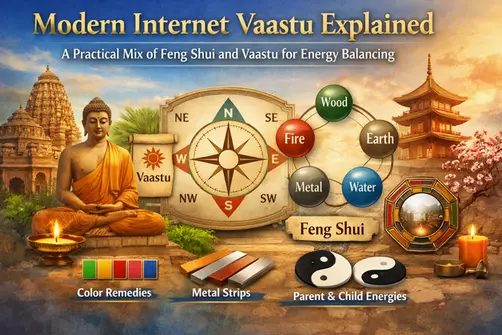
Many techniques commonly followed today under the name of Vaastu are not originally described in classical Vaastu texts. They are adaptations borrowed from Feng Shui, often without explicit acknowledgment.
This framework openly recognizes that influence.
Why Feng Shui Is Referenced Here
Feng Shui focuses heavily on visual cues, material response, and human psychology. Over decades, these techniques have shown practical results, especially in modern apartments and offices where structural corrections are limited.
Rather than rejecting or blindly adopting them, this system selectively integrates Feng Shui logic.
Use of Colors
The use of colors to strengthen or moderate a zone is largely derived from Feng Shui.
Colors act as visual frequency regulators. They influence mood, alertness, calmness, and focus.
In this framework:
• Parent colors are used to strengthen weak zones
• Child colors are introduced to absorb excess energy
This color logic is inspired by Feng Shui’s element balancing approach, not ritual symbolism.
Use of Metals and Metal Strips
The concept of placing metal strips or metallic objects to stabilize energy flow is also borrowed from Feng Shui.
Metals are treated as conductive and grounding materials, not magical cures.
Different metals behave differently:
• Copper activates and regulates
• Steel and iron ground and stabilize
• Silver reflects and softens
Their use here is functional and minimal.
Mirrors and Reflective Surfaces
Mirrors are a classic Feng Shui tool and are widely used in modern Vaastu advice.
In this framework, mirrors are treated as energy multipliers.
They:
• Increase activity
• Duplicate visual fields
• Amplify whatever already exists in a zone
This is why mirrors are used cautiously and never as a universal remedy.
Objects as Energy Anchors
Feng Shui uses objects as symbolic and functional anchors.
This system adopts only the functional aspect.
Objects are used to:
• Redirect attention
• Alter movement patterns
• Modify light and perception
They are not considered substitutes for structural logic.
Feng Shui Parent–Child Creation Cycle Used in This Framework
To understand why parent and child colors are used for balancing zones, it is important to understand the Feng Shui creation cycle, also called the productive cycle.
This cycle explains how one form of energy creates, supports, or feeds the next.
It is not used here as belief, but as a balancing logic.
The Five Energy Types in Feng Shui
Feng Shui classifies energy into five functional types:
• Wood (air)
• Fire
• Earth
• Metal
• Water
Each type supports the next in a predictable sequence.
The Parent–Child Creation Cycle
The creation cycle flows as follows:
• Wood creates Fire
• Fire creates Earth
• Earth creates Metal
• Metal creates Water
• Water creates Wood
In this relationship:
• The creator is the parent
• The created is the child
A parent strengthens the child.
A child absorbs excess energy from the parent.
This simple logic is what this framework uses for zone correction.
How This Cycle Is Applied Practically
Instead of working with abstract elements, this system translates them into colors, materials, and visual cues, which are easier to apply in modern spaces.
Examples:
• Green represents Wood energy
• Red, orange, pink represent Fire energy
• Brown and yellow represent Earth energy
• White, grey, metallic tones represent Metal energy
• Blue and black represent Water energy
Strengthening a Weak Zone Using Parent Energy
When a zone feels weak, inactive, or blocked:
• Parent energy is introduced
• Parent color is strengthened
• Supporting metal is added carefully
This helps the zone regain its natural function without forcing change.
Reducing Excess Using Child Energy
When a zone feels aggressive, unstable, or overwhelming:
• Child energy is introduced
• Child color absorbs overflow
• Reflective or softening materials are used
This prevents suppression while restoring balance.
16-Zone Detailed Table
| Zone | Core Energy Function | Parent Color (Strengthens Zone) | Child Color (Absorbs Excess) | When to Use Parent Color | When to Introduce Child Color | Metal Strip Remedy and Placement Logic |
|---|---|---|---|---|---|---|
| NNE | Intuition, ideation, subtle perception | Light yellow, off-white | Pale green | When clarity is low, ideas do not flow, guidance is missing | When overthinking, anxiety, mental fatigue dominate | Thin copper strip placed horizontally. Copper stabilizes subtle mental activity. Avoid iron |
| NE | Wisdom, clarity, vision | White, cream | Light yellow | When decision making is poor, direction feels lost | When detachment, delay, or excessive inward focus appears | Silver or chrome finish strip. Light reflective metals only |
| ENE | Learning, communication | Light green | Soft yellow | When focus, memory, or learning ability is weak | When nervous energy, chatter, or restlessness increases | Bronze or light copper strip with smooth edges |
| E | Growth, authority, recognition | Light green | Soft orange | When confidence, visibility, or leadership is weak | When ego clashes, aggression, or dominance shows | Copper strip, preferably vertical to support growth |
| ESE | Energy conversion, motivation | Orange | Muted red | When lethargy or lack of drive is observed | When anger, impulsive spending, or impatience appears | Copper strip only. Avoid iron which intensifies instability |
| SE | Fire, digestion, expenses | Red | Pink | When digestion, productivity, or action is low | When aggression, overheating, or conflicts increase | Copper strip anchored near kitchen or heat source |
| SSE | Regulation of aggression | Dark red | Brown | When suppressed anger or frustration exists | When emotional volatility and conflicts rise | Copper strip combined with grounding elements like stone |
| S | Stability, immunity, rest | Brown | Yellow | When insecurity, fatigue, or instability dominates | When heaviness, laziness, or depressive patterns appear | Iron or steel strip, heavier gauge preferred |
| SSW | Discipline, resistance, boundaries | Dark brown | Grey | When discipline is weak or boundaries are crossed | When rigidity, joint pain, or excessive control develops | Iron strip placed low and grounded |
| SW | Control, ownership, foundation | Dark brown, maroon | Beige | When authority, financial control, or leadership is weak | When dominance, emotional suppression, or rigidity shows | Thick iron or steel strip. Avoid copper here |
| WSW | Endurance, responsibility | Grey | White | When career stamina or responsibility handling is weak | When emotional coldness or isolation develops | Steel strip with matte finish |
| W | Results, output, closure | Grey | Blue | When results are delayed or tasks remain incomplete | When emotional detachment or over-analysis appears | Steel strip placed horizontally |
| WNW | Movement, execution | Blue | White | When execution speed or adaptability is low | When restlessness, instability, or frequent changes occur | Light mixed metals in moderation |
| NW | Travel, networking, interaction | White | Grey | When networking, opportunities, or communication reduce | When instability, anxiety, or inconsistency increases | Aluminum or light steel strip |
| NNW | Circulation, nervous balance | White | Silver | When nervous imbalance or confusion exists | When overthinking or hyperactivity dominates | Silver finish metal strip |
| N | Flow, finance, opportunity | Green | Blue | When cash flow, ideas, or growth stagnate | When over-expansion or scattered focus occurs | Polished steel or silver strip |
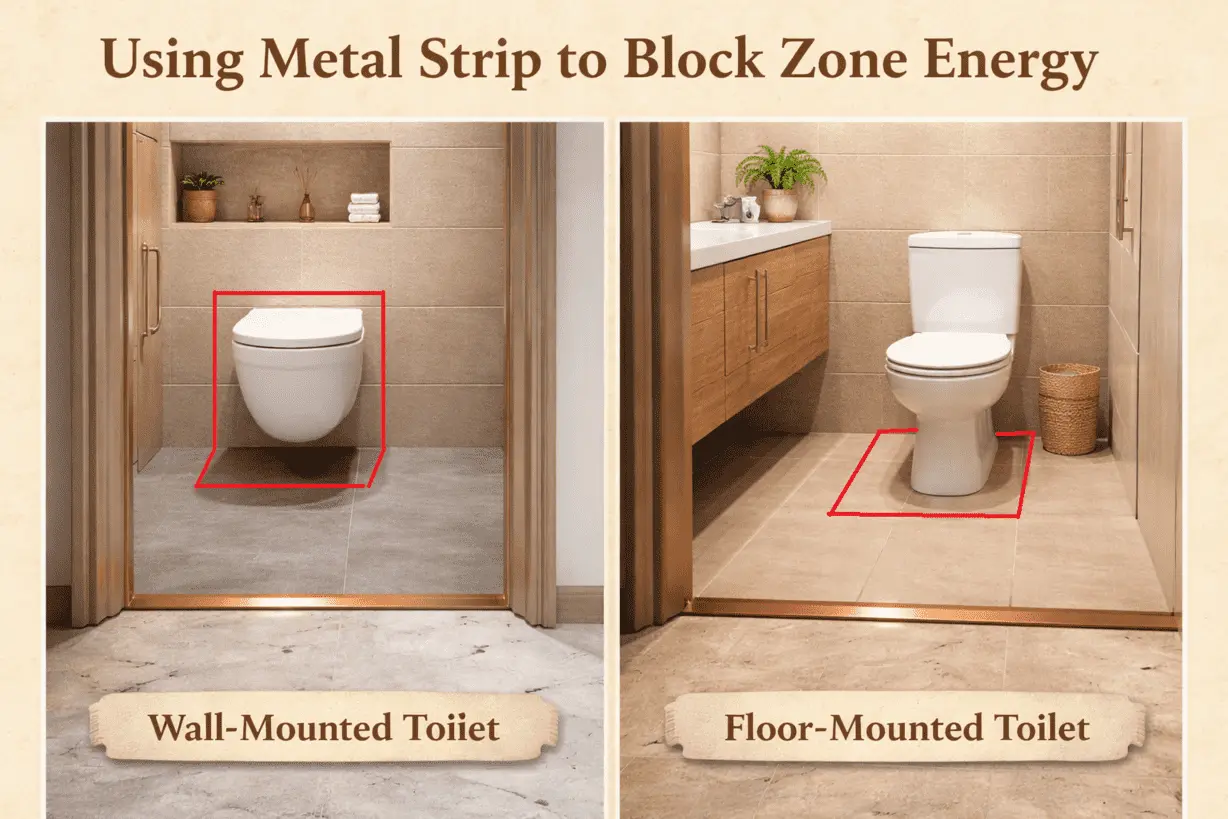
Similarly use of Metal strips in Toilets in wrong zones liek below:
Final Clarification
This hybrid approach does not claim purity.
It claims honesty and practicality.
Where Feng Shui contributes effective tools such as colors, metals, mirrors, and visual balancing, they are acknowledged openly and used responsibly.

Leave a comment
Your email address will not be published. Email is optional. Required fields are marked *